
At Synebra, we're building a system that captures the knowledge living in employees' heads and stores it in a structured Enterprise Brain that AI tools can query directly. Three foundational decisions shape how we build. We believe in making the right architectural decision early. Let us share our main 3 principles.
1. EU-first architecture
2. Voice as the primary input
3. Connect to your existing (AI) tools
1. EU-first architecture
We don't believe in bolting on compliance afterwards. That approach is increasingly untenable, particularly in Europe. For organizations operating under GDPR, with CIOs and DPOs accountable for where data flows and how it's processed, this isn't an option. EU-first architecture means every component runs in Europe from day one. All our data resides in Europe and we use Mistral AI for our LLM work. It means not designing a system where sensitive organizational knowledge transits through infrastructure outside your jurisdictional control and then scrambling to remediate it later. We made different choices about vendors, data models and integrations. Some of those choices cost more upfront. Most of them are cheaper in the long run.
2. Voice as the primary input
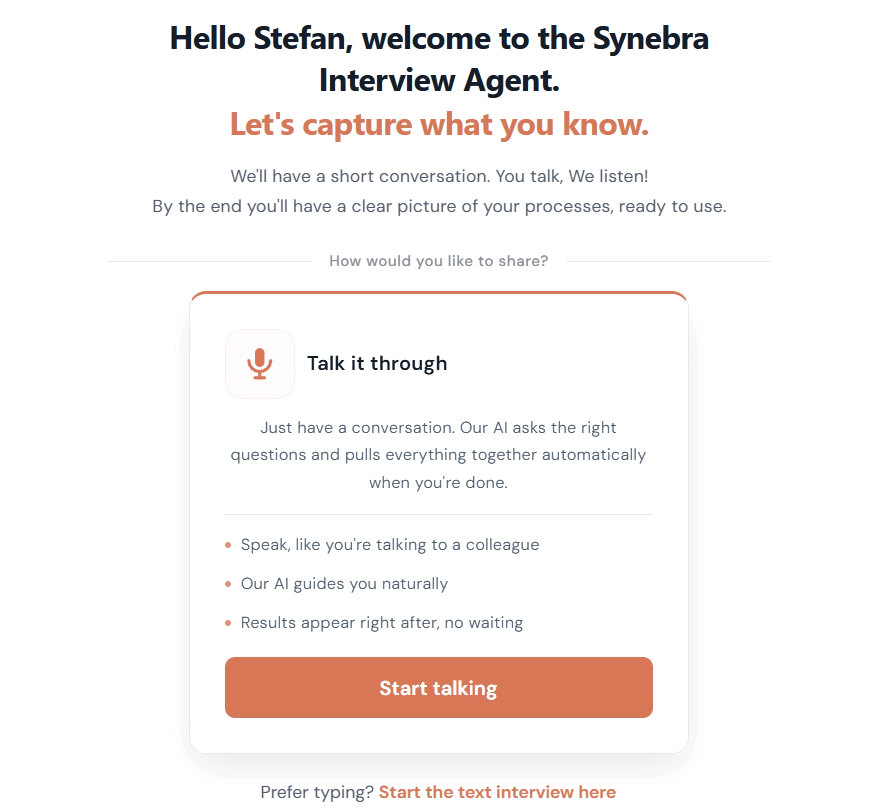
There's a huge gap between documented knowledge and how things actually work. Process documentation, wikis and knowledge bases capture a fraction of what employees know. It rarely reflects the operational reality. Real processes are rarely written down. Not because people are unwilling, but because legacy knowledge bases were built for a different era and are a poor fit for tacit, contextual knowledge. Voice is a better medium. A conversational interview surfaces the implicit knowledge that was never surfaced. A 10-minute natural conversation produces more usable signal than most documentation projects. The key is treating the interview itself as a knowledge extraction process, not a data entry method.
3. Connect to your existing (AI) tools
The assumption is that if you store it somewhere, people will find it. That assumption is simply wrong. Take the example of your AI tools. AI tools need access to enterprise context to produce reliable outputs. Without context, they'll drift. The architectural answer is to make captured knowledge directly queryable by AI tools via API or MCP. The knowledge stops living in a separate system that people have to remember to consult and becomes part of every AI-assisted conversation in the organization, surfaced automatically when relevant. We strongly believe in connecting your knowledge layer to all your existing (AI) tools so your team can use them to their full potential. That is why we make your knowledge layer plug & play with ChatGPT, Claude, Copilot or any other custom agent you already use.