
After many conversations with CIOs, COOs, CEOs, CDOs, BI leaders and ops teams, we clustered our insights into the 5 key reasons why companies are investing in one.
Before we dive into the reasons, let's define what an Enterprise Context Layer is. An Enterprise Context Layer is a centralized repository and a structured repository of operational reality. It includes processes, definitions, terminology, decisions, compliance rules and operational context. Instead of scattered documentation, it's a single source of truth that reflects how the business is actually run.
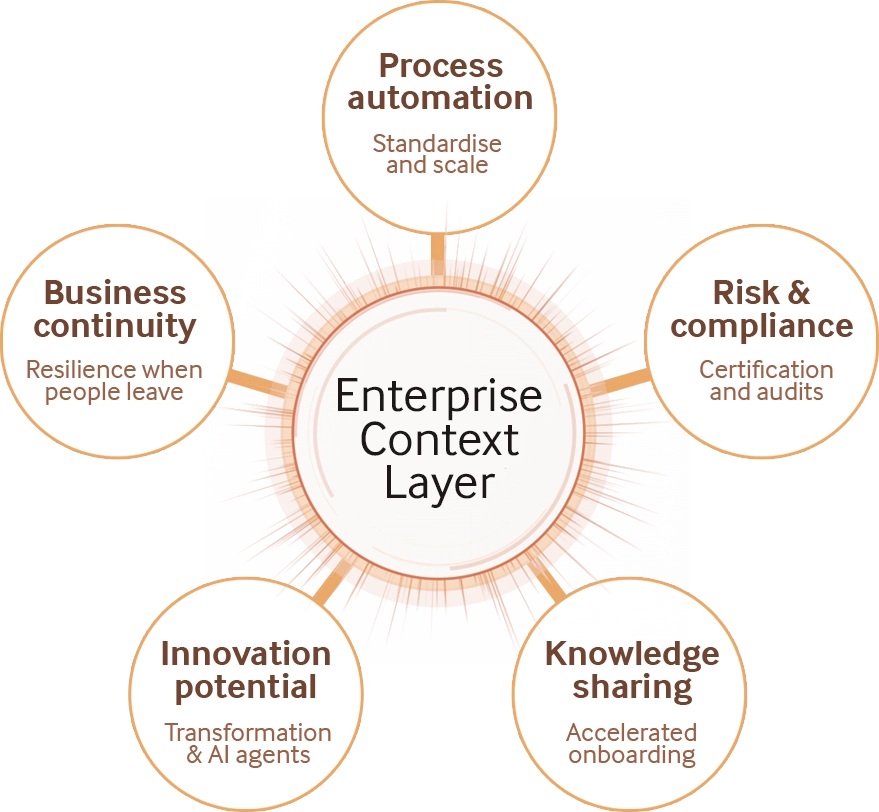
Now that we have a definition, let's dive into the 5 key reasons why companies are investing in an Enterprise Context Layer.
Process automation. It turns out you can't automate or improve what you don't know or cannot see. Standardisation and visibility are the foundation for scale. If we can't standardise processes, we can't make them work for all team members. It's also a prerequisite for AI agents to work effectively.
Risk & compliance. Nobody enjoys audits. But when urgency hits, SOC 2, ISO certifications, internal controls, structured documentation suddenly becomes business-critical. It's normal for teams to adopt work-arounds to fix things temporarily. It's important to surface these shadow processes before they become a risk.
Innovation potential. AI agents are only as effective as the context they can access. With the arrival of AI, a central context layer directly impacts your transformation readiness. If your agents can't access the right context, they'll drift and agents created by different team members will behave differently.
Business continuity. When people leave, knowledge walks out the door with them. That's a high price to pay and this is often a hidden cost. This problem often appears in legacy orgs where senior team members hold the knowledge. Don't document last minute, document early while you are still building things.
Knowledge sharing. Reduce the onboarding time of new hires. Combine your enterprise knowledge layer with an AI agent to train your new team members. Reuse internal knowledge, you'll be surprised how many people and departments are re-doing exactly the same thing. Many are looking for the same knowledge. People reinvent the wheel daily.
The cost of building an Enterprise Context Layer is small compared to the long-term return it creates. In upcoming posts, we'll dive into the biggest barriers companies face when trying to document and structure knowledge.
Because the elephant in the room is:
“If the benefits are so obvious, why doesn’t every company have an Enterprise Context Layer?”