
Looking for a strong AI use case to boost productivity? Here is one that is high-impact, often overlooked and closer to daily work than most transformation roadmaps admit. Improving how employees access internal knowledge.
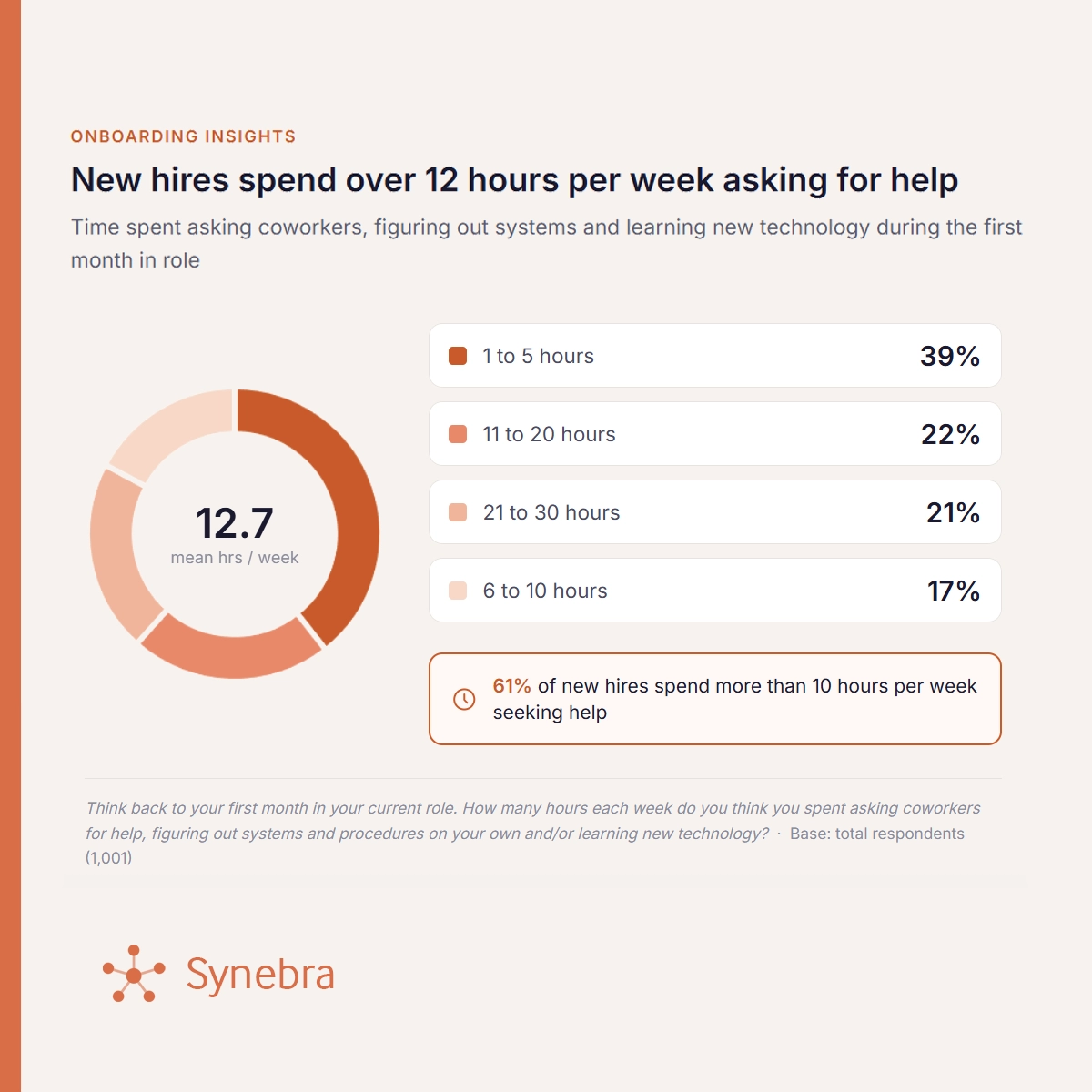
Roughly 20% of knowledge workers' time goes to searching for internal information. Most still do not find what they need. New hires feel it most: 12+ hours per week asking colleagues for help. That is 50+ hours in the first month alone.
From a business perspective you get three structural issues:
Reduced productivity per FTE. Time hunting for answers is time not spent on customer work, delivery or improvement.
Increased dependency on key individuals. When answers live in people's heads, throughput bottlenecks on whoever knows the most.
Inconsistent execution across teams and AI. Without shared current context, teams interpret processes differently. AI tools inherit the same gaps.
Zoom out and the pattern is clear: accessible knowledge.
Typical failure points:
Knowledge is never fully captured. A lot stays in people's heads and never makes it into a durable system.
Documentation goes stale quickly. Wikis and playbooks drift from how work is actually done.
Information is scattered across tools. Confluence, SharePoint, Slack threads, slide decks and more.
Search does not reliably surface the right answer. Even when content exists, findability fails.
So teams fall back to the oldest default: asking a colleague. Expensive. Slow. Not scalable.
AI can change this. A modern knowledge layer makes information easier to gather. It also makes it searchable, contextual and usable in real time.
As a bonus it is the foundation for any AI strategy in the company. No central knowledge layer, no scalable AI. You might as well start now.
Productivity figures in this article draw on the Panopto and YouGov workplace knowledge study.